About the Book
A Fresh Approach to Slavery and the American Civil War
The standard history of the American Civil War cam be summarized in three simple sentences:
Enslavers started it.
The Confederacy lost.
Slavery ended.
All of these are true—in the narrow context of U.S. history.
However, when seen in the broader context of their time—of the other secessions, wars, and abolitions occurring around the world in the 1800s—they raise provocative questions:
Enslavers started it—but enslavers nowhere else in the Americas started a war to protect slavery. Why was U.S. slavery exceptional?
The Confederacy lost—but all other major secessionist movements in the Atlantic world (Ireland, Poland, Hungary, etc.) that also lost rose again and again until they won independence. Why was the South exceptional?
Slavery was abolished—but no other post-slavery country developed a tradition of public, sadistic lynching designed for racial terror. Why were U.S. race relations exceptional?
The answers to these questions and others provide a challenging new perspective on slavery and the American Civil War.
Through the stories of 14 key individuals (half from the United States and half from other countries) the book compares U.S. developments with slavery in the Caribbean, secession in Hungary, emancipation in Russia, civilian deaths in China, nation-building in Germany, lynching in South Africa, and post-war reconciliation in Japan.
What these stories show is that the United States is indeed an exceptional country—but not always in the ways people assume.
The Exceptionalism of U.S. Slavery Captured in Two Images and a Chart
South Carolina

The Caribbean

South Carolina: An enslaved family on Smith's Plantation, Beaufort, South Carolina, circa 1862. Image courtesy of the Library of Congress and learnnc.org. Timothy H. O'Sullivan, public domain, via Wikimedia Commons.
The Caribbean: Enslaved men harvesting sugar cane, probably in the Caribbean. Author unknown, public domain, via Wikimedia Commons.
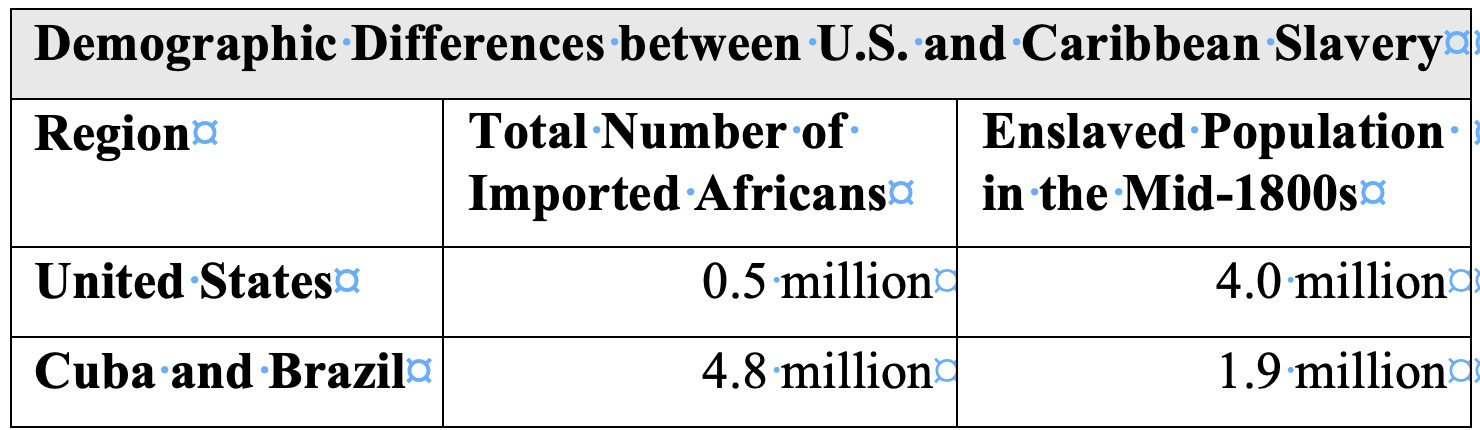
Children were a key part of enslaved families in the cotton and tobacco plantations in the United States but not in the sugar plantations of the Caribbean and Brazil.
Many historians have noted that the United States raised its enslaved labor force while countries purchased theirs. Few have followed the implications of this difference to help explain why the fear of abolition caused a civil war in the United States—but in no other country.
Contents
Introduction: The American Civil War in Global Context
1. Exceptionalism: Reckoning with What Makes Americans American
What does—and what does not—make the United States exceptional?
2. Slavery: The Peculiar Institution’s Peculiar End:
Why was the United States the only country in the Americas where enslavers started a war to protect slavery?
William Gardner, an enslaved Virginian
Jonas Bath, an enslaved Trinidadian
3. Secession: The Sudden Collapse of Southern Nationalism
Why were Southern nationalists the only significant secessionist movement of the 1800s in the Americas and Europe that did not result in an independent country by the end of the 1900s?
Edmund Ruffin, a Confederate nationalist
Louis Kossuth, a Hungarian nationalist
4. Emancipation: The Dilemma of Distributing Land to Freedpeople
What could the United States have learned from Russia about reducing the fears among free workers before emancipation and helping freedpeople prosper after it?
James Gordon Bennett, a newspaper publisher in New York
Alexander II, the tsar of Russia
5. Death: Famine and Disease Among Southern Civilians
Why did pro-rebellion civilians account for such a small percentage of American Civil War deaths compared to similar groups in other large wars in the mid–1800s?
Mary Jackson, the leader of a bread riot in Richmond, Virginia
Hong Xiuquan, the leader of the Taiping Civil War in China
6. Nation-Building: The Postwar Decline in Southern Planters’ Power
Why was the postwar landed elite weaker in the United States than in other countries?
Justin Morrill, a senator from Vermon
Otto von Bismarck, the chancellor of Germany
7. Lynching: The Brutal Cost of Distrust in Government
Why was the United States the only post- slavery society where lynching emerged as a common form of racial terrorism in the late 1800s?
Ida B. Wells- Barnett, a U.S. anti- lynching activist and journalist
Maurice Evans, a South African politician and writer
8. Reconciliation: The Role of History in the Country’s Failure to Unite
Why was the United States one of the few countries to try reconciliation and the only country where it failed in the mid– 1800s?
Edward Pollard, a Virginia writer
Saigō Takamori, a Japanese military leader
9. Conclusion: A Case Study in American Exceptionalism
How did the peculiar traits of slavery in the United States make the American Civil War—and the United States generally—exceptional?
Full Reviews
“Strickler’s Let Us Die to Make Men Free makes great use of the ‘global turn’ in U.S. history to make a significant contribution to histories of the Civil War and American exceptionalism. This very engaging book is filled with biographical sketches and smart global comparisons that will draw you into the story while also packing an interpretive punch. Strickler offers particularly perceptive ideas about why and how southern enslavers used exceptional force to try and protect the institution of slavery and to reestablish white supremacy in ways with lasting legacies for Black people and for all of United States history.”—Sarah Purcell, L.F. Parker Professor of History, Grinnell College, author of Spectacle of Grief: Public Funerals and Memory in the Civil War Era
“Strickler’s genius is to cast this quintessential American story of slavery and civil war onto a vast, cosmopolitan stage while combining it with a collection of vivid personal stories that make his telling both intelligible and captivating.”
—Don H. Doyle, McCausland Professor of History, Emeritus, University of South Carolina, author of The Cause of all Nations: An International History of the American Civil War and The Age of Reconstruction: How Lincoln’s New Birth of Freedom Remade the World
“There are many books out there on the Civil War but few have the atypical perspective of this fine work. Drawing on historical events from around the world occurring at approximately the same time period it comparatively delineates what was ‘exceptional’ about our experience and what wasn’t and enhances our understanding of the Civil War and its aftermath. I recommend it highly.”
—Paul B. Fischer, emeritus professor, Department of Politics, Lake Forest College, and has written extensively on federal race and housing issues
“James Strickler has done the near-impossible: offered a fresh take on the most written-about topic in U.S. history, the Civil War. Exploring the vaunted concept of American exceptionalism, he compares Southern slavery and the brutal war it provoked to forced labor, internal conflict, and nation-building across the globe. Hidden truths emerge about the South’s ‘peculiar institution,’ secession, and the Civil War itself. This provocative and well-written book shows us that the U.S. was indeed exceptional—but not in the ways most of us have thought.”
—Deborah R. Weiner, former research historian at the Jewish Museum of Maryland and author of Coalfield Jews: An Appalachian History
“James E. Strickler’s Let Us Die to Make Men Free is an eye-opening, much-needed examination of the idea of American exceptionalism in the context of slavery and the Civil War. Strickler compares and contrasts the U.S. versions of enslavement, emancipation, lynching, secession, civilian deaths, nation-building and reconciliation to the experience of other nations in the same era, and he finds that the United States was truly exceptional—in good and bad and often surprising ways. His book shows that the nation’s claim to exceptionalism is a two-edged sword. It also reveals that there is much to learn about the Civil War when viewed from the perspective of the rest of the globe.”
—Patrick T. Reardon, former member of the Abraham Lincoln Presidential Library board and author of The Loop: The “L” Tracks That Shaped and Saved Chicago
“If you think you understand the Civil War, think again. James E. Strickler explores the fraught topics of the war and American exceptionalism through a global frame—and the result is a fascinating reconsideration of American history. Let Us Die To Make Men Free is informed by rigorous scholarship and guided by the need to make the insights of modern historians accessible to a wider audience. In an era when politicians demand we simplify stories of our past, Strickler provides a timely reminder that American history is more complicated, and more fascinating, than a collection of hagiographic bromides.”
—Robert B. Mitchell, author of The Partisans: James G. Blaine, Roscoe Conkling, and the Politics of Rivalry and Revenge in the Gilded Age
“Dangerous constitutional moments occur throughout history and in all parts of the world. The transition from the Roman Republic to the Roman Empire, the re-imagining of the British State after the trial of Charles I, the fatal deconstruction of the Weimar Republic by the Nazis—all come to mind. In a way the American Civil War was part of that legacy—another episode of yet another dangerous constitutional moment. But it was also different as this book admirably demonstrates. Ideas and power rivalries always intermix.
But here the ideas assume central importance. Here, the unrealized ideal of the essential equality of all of humanity fueled a different kind of dispute. And the outcome has been likened to a ‘second founding’ of the Republic. The chief merit of this book is that it places the American Civil War in a much broader context of world history. Both the continuities and the discontinuities of that context form the core of this book. As such it makes a distinctive contribution to the corpus of works in the field and should stimulate further scholarly attention.”
—Gerard Quinn, professor of law at the University of Leeds and University of Lund, former professor of law at the National University of Ireland Galway, and former UN Special Rapporteur on the Rights of Persons with Disabilities
There’s no doubt that Jim‘s 30 years of research and writings have been artfully put to use in writing Let Us Die to Make Men Free.This book is a legacy gift to all who wish to have a deeper, clearer and much more honest conversation about American exceptionalism.
For the lessons in this book can guide our thinking and actions even in this time and spaces when Americans are questioning our past, struggling with our present and trying to envision our collective future.
Jim brings in the voices and thoughts of leading thinkers, introducing readers to many unknown characters, revealing and connecting their stories to the shaping of American behavior. He consistently and honestly exposes readers to both sides of arguments that shaped our nation yesterday, today and possibly tomorrow.
Let Us Die to Make Men Free can serve as a case study on how slavery and the Civil War shaped the idea and reality of American Exceptionalism that scholars, teachers, policy makers and all who love our country would be well served by reading. For this book is about us. It is our story!
—David Hunt, Founder of the Community Building Storytelling Project and author of Relevancy in Retirement: Stories and Strategies from People Who Found Purpose in Retirement